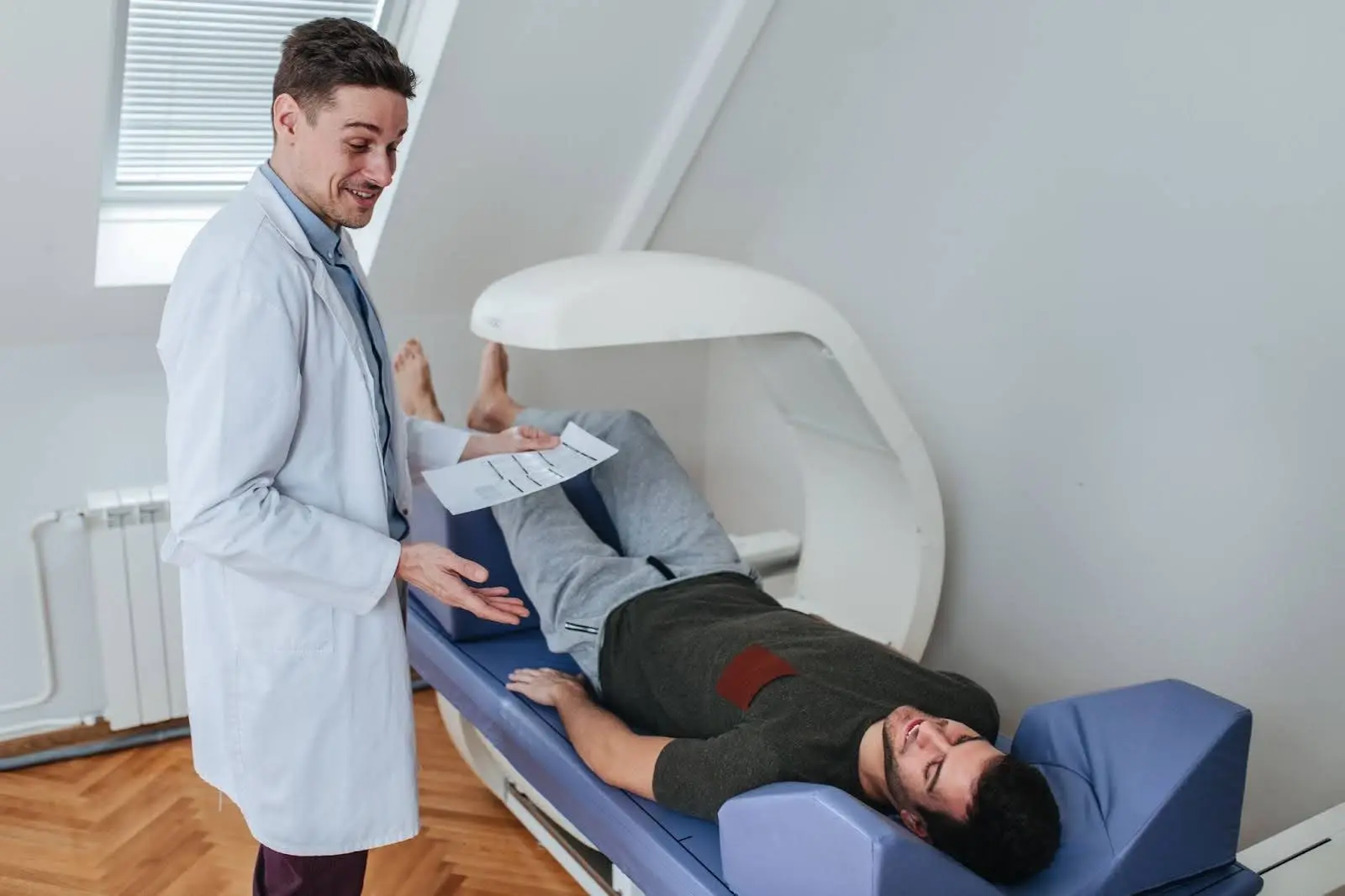
As residents of Central Texas, we’re often proactive about our health, scheduling regular check-ups and screenings. When your doctor orders a Dual-Energy X-ray Absorptiometry (DEXA) scan, it’s usually to assess your bone mineral density (BMD)—a crucial measure for diagnosing osteoporosis or assessing fracture risk.
A common and important question that arises is: can a DEXA scan show cancer? The short answer is no, a DEXA scan is not designed as a primary cancer screening tool. However, the data it collects can sometimes provide indirect clues that prompt a physician to order further, more specific diagnostic tests.
What a DEXA Scan Is—and Is Not
To understand what a DEXA scan can and cannot do regarding cancer detection, it’s helpful to clarify its primary purpose.
The Purpose of a DEXA Scan
A DEXA scan is an advanced type of X-ray that uses very low doses of radiation to measure the amount of calcium and other minerals in your bones. Its main goal is to produce a detailed, quantitative report on bone mineral density (BMD), usually focusing on the hips and spine.
- Primary Diagnostic Use: Diagnosing and monitoring conditions like osteopenia (low bone mass) and osteoporosis (porous bones).
- Risk Assessment: Determining your risk of experiencing a bone fracture.
- Body Composition Analysis: Increasingly, DEXA scans are also used to measure lean mass and fat mass (body composition analysis), which is valuable for weight management and fitness tracking.
The technology is specifically tuned to differentiate between bone tissue and soft tissue, allowing for a precise measurement of bone density. This specialization means it excels at bone health metrics but lacks the detail needed to visualize or characterize tumors in the way that other imaging modalities can.
Why It Isn’t a Cancer Screening Tool
The image produced by a DEXA scan is a simplified, two-dimensional projection. While it clearly highlights the bone structure, it doesn’t offer the high-resolution, cross-sectional views of soft tissues (like lungs, liver, or lymph nodes) that are necessary for early cancer detection.
Cancer screenings like mammograms, colonoscopies, and imaging tests like CT scans or MRIs are specifically optimized to detect subtle changes, masses, or abnormalities in soft tissues where most cancers originate.
The Indirect Connection: When Bone Density Changes Matter
While the question “can a DEXA scan show cancer?” is typically answered in the negative, it is possible for the results to indirectly alert your doctor to a potential underlying issue, including certain types of cancer.
Certain cancers, particularly those that originate elsewhere and spread (metastatic cancer), can affect bone health. When a DEXA scan reveals unexpected or severe changes in BMD, it can be a sign that something is compromising the skeletal system.
Bone Changes That May Warrant Further Investigation:
- Unexplained Osteoporosis or Bone Loss: Cancers like multiple myeloma or cancers that have metastasized to the bone (e.g., from the breast, prostate, or lung) can disrupt the body’s natural cycle of bone breakdown and formation. If a patient is too young for typical age-related osteoporosis, or the bone loss is unusually aggressive, a physician might investigate cancer as a contributing factor.
- Focal Lesions: Although DEXA is not ideal for soft tissue, a large or dense bone lesion (an area of abnormal or damaged bone tissue) may show up as an area of increased or decreased density. If the radiologist notes a suspicious focal area rather than uniform bone loss, it will lead to recommendations for a follow-up imaging study (like a bone scan or MRI) to determine if it is a benign issue or a malignant tumor.
- Body Composition Anomalies: Extreme and unexplained loss of lean body mass (sarcopenia) seen in the body composition analysis part of a DEXA scan can sometimes be a non-specific indicator of chronic illness, including certain cancers that cause rapid muscle wasting (cachexia).
DEXA Scan vs. Other Bone Imaging
If your doctor suspects cancer involving the bones, they will order a specialized diagnostic test. These tests provide the detailed, three-dimensional information necessary for an accurate diagnosis.
- Bone Scan (Nuclear Medicine Scan): This is a key tool for detecting cancer that has spread to the bones (metastasis). A small amount of radioactive tracer is injected, which accumulates in areas of rapid bone turnover, highlighting potential tumors, fractures, or infections.
- CT Scan (Computed Tomography): Provides cross-sectional X-ray images that are much more detailed than a standard X-ray or DEXA scan, excellent for viewing bone and soft tissue masses.
- MRI (Magnetic Resonance Imaging): Uses magnetic fields and radio waves to create highly detailed images of soft tissues, often used to confirm the nature of a bone lesion seen on other scans.
How Prime Wellness and Longevity Uses DEXA to Transform Your Health
At Prime Wellness and Longevity, we view a DEXA scan as much more than just a bone density check. While it provides critical information regarding your skeletal health, we utilize this technology as a high-precision roadmap for your entire wellness journey. By integrating DEXA data into our comprehensive health protocols, we help our Central Texas patients move beyond “normal” and achieve “optimal.”
Frequently Asked Questions (FAQ)
Can a DEXA scan diagnose multiple myeloma?
No. While multiple myeloma, a cancer of the plasma cells, severely affects the bone marrow and can cause significant bone loss that a DEXA scan would measure, the scan cannot definitively diagnose the disease. Diagnosis requires blood tests, urine tests, and a bone marrow biopsy.
If my DEXA scan is normal, does that mean I don’t have bone cancer?
Not necessarily. A normal DEXA scan primarily indicates healthy bone density. It does not rule out the presence of early-stage metastatic cancer that has not yet caused significant bone destruction. DEXA scans are not a replacement for comprehensive cancer screening.
Should I worry if my DEXA scan showed a low T-score?
A low T-score (indicating osteopenia or osteoporosis) means you have a higher risk of fracture. While this is the main concern, it’s also a cue for your doctor to investigate why your bone density is low, which may involve blood work or other tests to rule out contributing factors, including rare conditions or cancers.
DEXA Scans: A Cornerstone of Bone Health, Not Cancer Screening
While the question can a DEXA scan show cancer carries deep importance for patients, it is critical to remember the scan’s specialized role. A DEXA scan is an unparalleled tool for quantifying bone health, detecting osteoporosis, and providing valuable body composition data that supports overall wellness efforts here in Central Texas. At Prime Wellness, we utilize advanced diagnostics, including our in-house DEXA scanner, as part of a comprehensive approach to health and longevity.